The Morse Code Alphabet: Every Letter, Number & Symbol
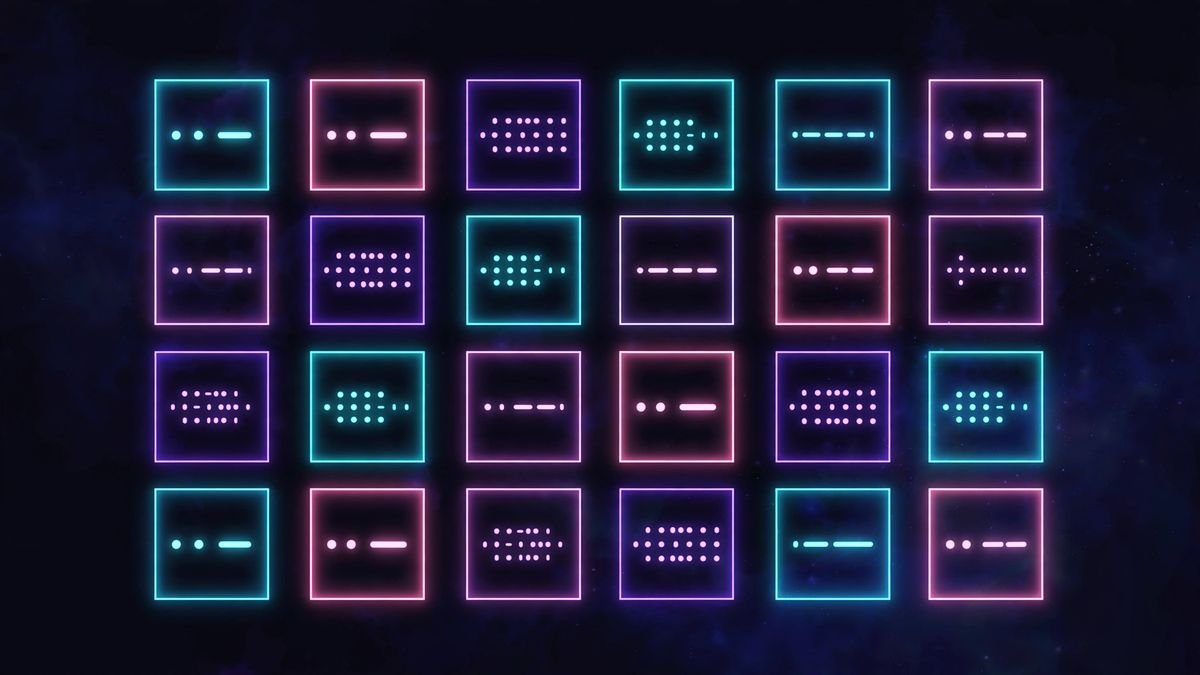
What Is the Morse Code Alphabet?
The morse code alphabet is the complete set of dot-and-dash patterns that stand for letters, numbers, and punctuation in International Morse Code. Every letter from A to Z has its own unique rhythm — a short pattern of dots (dits) and dashes (dahs) — and so does every digit from 0 to 9. The chart below is the full international standard, the same one maintained by the ITU (International Telecommunication Union) and used by ham radio operators, aviation beacons, and maritime stations around the world.
A few things to know before you dive into the chart. First, there is no difference between uppercase and lowercase — A and a are the same pattern. Second, the patterns you see here are the International Morse Code; an older American variant existed, but it is obsolete (more on that below). Third, and most importantly: this chart is a reference, not a learning method. Staring at it will help you check a character, but if you actually want to learn the code, you need to hear the sounds — which is why this page also teaches you the pattern logic behind the alphabet, the dichotomic tree, and how to memorize the whole thing properly. Our how to learn morse code guide covers that in full depth.
The Complete Morse Code Alphabet Chart (A–Z)
Here is every letter of the international morse code alphabet. Click a letter for its dedicated guide with audio, hand signals, and practice drills — or hit the play button on any card to hear it at 12 WPM.
Look closely and you will start to see the hidden order. The two shortest patterns in the entire system belong to the two most common letters in English: E is a single dot and T is a single dash. That was a deliberate design decision — the alphabet is weighted by frequency, so the letters you send most often take the least time. Letters with two elements (A, I, M, N) are also extremely common, while rare letters like J, Q, X, and Z get the longest four-element patterns. No letter in the international alphabet is longer than four elements.
Want a version you can print and pin to your wall? Grab the printable morse code chart — it has the full alphabet, numbers, and punctuation on one page.
Morse Code Numbers 0–9
Every digit in morse code uses exactly five elements — no more, no less. That uniformity makes numbers instantly recognizable: when you hear five elements in a row, you know you are hearing a digit. And there is a beautiful mirror pattern that makes them far easier to memorize than they look.
See the symmetry? Numbers 1 through 5 start with dots and count up (1 dot, 2 dots, 3 dots, 4 dots, 5 dots), with dashes filling the rest. Numbers 6 through 9 are the mirror image: they start with dashes and count up (1 dash, 2 dashes, 3 dashes, 4 dashes), with dots filling the rest. Zero and five are the anchors: five dashes and five dots. Once you see this, memorizing all ten digits takes minutes instead of hours. For a deeper dive with audio drills and practice exercises, see our dedicated morse code numbers guide.
Punctuation in Morse Code
Punctuation exists in morse code too — and yes, there is even a pattern for @ (.--.-.), which the ITU added to the international standard in 2004, the first new character in decades. The most useful punctuation marks for everyday use are:
| Mark | Morse code | Mark | Morse code |
|---|---|---|---|
| Period . | .-.-.- | Question mark ? | ..--.. |
| Comma , | --..-- | Exclamation ! | -.-.-- |
| Slash / | -..-. | At sign @ | .--.-. |
Punctuation patterns are longer (six elements each) and are sent much less often than letters, so most learners save them for last. If you want the full set — including colons, semicolons, quotes, parentheses, and the prosigns — head to our complete morse code punctuation chart.
Why the Alphabet Looks Random (But Isn't)
At first glance, the letter assignments look arbitrary — why is C (-.-.) so much longer than E (.)? The answer is engineering, not randomness.
Frequency weighting
When Samuel Morse and Alfred Vail were developing their code in the 1830s and 1840s, they understood a basic efficiency principle: the most-used letters should be the fastest to send. So E, the most common letter in English, got the shortest possible code — a single dot. T, the second most common, got a single dash. The next tier of common letters (A, I, M, N) got two-element codes, and the rare letters (J, Q, X, Z) got the longest four-element codes. According to the traditional story, Vail estimated letter frequencies by counting the movable type in a printer's type case. Whether or not that story is literally true, the frequency logic is visible in every chart: short codes track common letters.
The 1848 redesign
What you see today is not exactly what Morse and Vail built. The modern International Morse code — sometimes called the "continental code" — was created by Friedrich Clemens Gerke in 1848 for telegraphy between Hamburg and Cuxhaven in Germany. Gerke changed nearly half of the alphabet and all of the numerals, eliminating the variable-length dashes and internal letter spaces of the original American system and leaving only two clean elements: the dot and the dash. His version was adopted in Germany and Austria in 1851, and after some refinements — the codes for O and P came from a system developed by Steinheil, a new codepoint was added for J since Gerke had not distinguished I from J, and X, Y, and Z were changed — it was standardized by the International Telegraph Convention in Paris on 17 May 1865. That convention created the International Telegraph Union, the forerunner of today's ITU, which still maintains the code as the international standard. Of the original Morse/Vail codepoints, only four survived into the international code: E, H, K, and N (and even K and N had their dashes lengthened to full dashes).
One rule, no exceptions
The international code's great strength is its mathematical consistency: a dash is always three times a dot, and every gap follows a fixed ratio. That consistency is why it won globally, why it is easier to learn than the American original, and why timing — not memorization — is the real heart of the code.
The Dichotomic Tree: Finding Any Letter in Four Questions
One of the oldest teaching tools in morse code is the dichotomic search tree — sometimes called the E-I-S-H tree. It is a binary tree where you start at the root and branch left for every dot and right for every dash until you run out of elements. You are asking, at most, four questions: "dot or dash?" repeated until the letter appears.
Walk down the dot side first. Start with a dot and you land on E. Another dot takes you to I, a third to S, and a fourth to H — the E-I-S-H chain that gives the tree its nickname. From H, one more dot gives you 5 (.....) and a dash gives you 4 (....-). Step back to S and take a dash instead: V (...-). Back at I, take a dash: U (..-), and from U a dot gives F (..-.) and a dash gives 2 (..---). The second-level branch, A (.-), splits into R (.-.) on the dot side — which further splits into L (.-..) and W (.--) — and W itself branches to P (.--.) and J (.---), with 1 (.----) hanging off J.
Now the dash side. A dash from the root gives T. Another dash: M. A third: O. The T branch also splits left into N (-.), which branches to D (-..) — the parent of B (-...), X (-..-), and 6 (-....) — and K (-.-), the parent of C (-.-.) and Y (-.--). The M branch splits into G (--.) and O (---); G branches to Z (--..) and Q (--.-), while O extends to the remaining digits: 7 (--...), 8 (---..), 9 (----.), and 0 (-----).
Written out, the letter-only tree looks like this:
                        (start)
                      . /     \ -
                    E           T
                 . / \ -     . / \ -
                I     A     N     M
              . / \ - . / \ - . / \ - . / \ -
             S   U R   W D   K G   O
            ./ \- ./ \- ./ \- ./ \- ./ \- ./ \-
           H  V F  L  P  J  B  X  C  Y  Z  Q
Why does this matter? Because the tree reveals the code's true nature: it is a prefix code. No letter's pattern is the beginning of another letter's pattern, which means a sequence of dots and dashes can always be split into letters unambiguously — as long as the timing gaps are correct. The tree is also a memory aid: if you know that H lives at the bottom of the all-dots branch and O at the bottom of the all-dashes branch, you can reconstruct any letter by walking the tree instead of memorizing 26 isolated facts.
International Morse vs American Morse: A Quick Note
You will occasionally see references to "American Morse code" (also called railroad code). This was Morse and Vail's original 1840s specification, used for land-line telegraphy in the United States and Canada. It used different-length dashes, dots with different spacing, and even pauses inside letters — which made it harder to learn, harder to send by hand, and unreliable across different technologies. Gerke's 1848 redesign and the 1865 Paris standardization replaced it everywhere that mattered, and today American Morse survives only in historical re-enactments. Everything on this site — and every chart, tool, and trainer we link to — uses International Morse Code. If you learn one code, learn this one.
How to Read These Patterns: The Timing Rules
A chart of dots and dashes is only half the story, because morse code is really a code of time. The international standard defines five timing rules, all measured in units where one unit equals the length of a dot:
- A dot lasts 1 unit; a dash lasts 3 units
- The gap between elements inside a letter is 1 unit
- The gap between letters is 3 units
- The gap between words is 7 units
Speed is measured in words per minute (WPM) using the standard word PARIS, which is exactly 50 units long — at 20 WPM, a single dot lasts just 60 milliseconds. That is why experienced operators never count dots and dashes: at real speeds there is no time to count; there is only time to recognize the rhythm. For a full step-by-step tutorial with worked decoding examples, see how to read morse code. And if you would rather hear the code than read about it, type any text into the morse code translator and listen to the timing engine play it back at any speed you choose.
7 Ways to Actually Memorize the Alphabet
Having the chart is not the same as knowing the code. These seven techniques are how real learners internalize all 26 letters — and they work far better than staring at the table.
1. Learn by sound, never by sight. This is the single most important rule. Your goal is to hear di-DAH and think "A" instantly, the way you hear a friend's voice and know who it is. Do not memorize the visual pattern .- and translate it in your head; that creates a lookup step you will have to unlearn later. Use audio tools — the morse code translator with playback, or a dedicated trainer — from day one.
2. Start with the mirror pairs. E (.) and T (-) are the two atoms of the code. Then learn the pairs that mirror each other: A (.-) and N (-.), I (..) and M (--), S (...) and O (---), H (....) — these form the spine of the dichotomic tree, and everything else hangs off them.
3. Learn in pattern families, not alphabetical order. Group letters by shape: the dot-led family (E, I, S, H), the dash-led family (T, M, O), the alternating family (A, N, K, R, C), and the long-tail family (J, Q, X, Z, P, Y, B, D, F, G, L, U, V, W). Families give your memory hooks; the alphabet gives it 26 disconnected facts.
4. Use the number mirror. The digits 1–5 and 6–9 are mirror images (see the numbers section above). Learn 1–5 first, then derive 6–9 by flipping dots and dashes.
5. Say the rhythms out loud. Voicing patterns as "di-dah" engages a different memory channel than reading dots. Walk around saying letter rhythms under your breath — di-DAH-dit for R, DAH-di-DAH for K — until they feel like words. Operators have done this for over a century.
6. Try mnemonics — with open eyes. Word-phrase mnemonics ("God save the Queen" has the rhythm of Q: DAH-DAH-di-DAH) can jump-start memorization, and Baden-Powell included a mnemonic chart in the Girl Guides handbook as early as 1918. They are fun and they work for getting started — but be honest with yourself: a mnemonic adds a middle step (sound → phrase → letter), so plan to drop the crutch once the sound feels familiar. Our how to learn morse code guide weighs the pros and cons in detail.
7. Drill with the Koch method. The most effective structured approach, developed by German psychologist Ludwig Koch in 1936, teaches just two characters at full speed and adds a new one only when you can copy the current set at about 90% accuracy. Because you never learn a character slowly, you never build the counting habit. Our 30-day plan in the learning guide is built on exactly this principle.
Your next steps
You now have the complete reference. Here is the most useful order to use it in: first, bookmark this page as your lookup chart. Second, print the printable morse code chart for your desk. Third, open the morse code translator, type your name, and listen to what it actually sounds like — the gap between reading .- and hearing di-DAH is the whole journey. Fourth, when you are ready to commit, follow the 30-day learning plan and work through the alphabet methodically. The code has survived nearly two centuries because it is simple, robust, and learnable — 26 letters, 10 numbers, and a handful of marks are all that stand between you and the world's most elegant signaling system.
Frequently asked questions
What is the morse code alphabet?
The morse code alphabet is the set of dot-and-dash patterns representing A–Z, 0–9, and punctuation in International Morse Code. Each letter has a unique rhythm of dots (dits) and dashes (dahs) — for example, A is .-, B is -..., and the most common letter, E, is a single dot. The full chart above lists all 26 letters plus numbers and punctuation.
How many letters are in the morse code alphabet?
There are 26 letter patterns (A–Z), plus 10 digit patterns (0–9) and a set of punctuation marks and prosigns. No letter pattern is longer than four elements; digits all use exactly five.
What is E in morse code? Why is it so short?
E is a single dot (.). It is the shortest pattern in the code because E is the most common letter in English, and the code was deliberately weighted by frequency — the letters you send most often take the least time. See the E in morse code guide for audio and drills.
What is the difference between International and American morse code?
International Morse Code (standardized 1865, maintained by the ITU) uses only dots and dashes with strict timing ratios. American Morse (the 1840s original) used variable-length dashes and internal letter spaces, making it harder to learn and less reliable. American Morse is now obsolete except in historical re-enactments; everything on this site uses the international standard.
Is there a morse code alphabet song or easy memorization trick?
The most reliable approach is learning by sound with the Koch method — two characters at full speed, adding one at a time at 90% accuracy. Mnemonic phrases (like "God save the Queen" for Q) can help you get started, and grouping letters into pattern families (dot-led, dash-led, alternating) beats alphabetical memorization. Details in our how to learn morse code guide.
What are the numbers in morse code?
All ten digits use exactly five elements: 1 is .----, 2 is ..---, 3 is ...--, 4 is ....-, 5 is ....., 6 is -...., 7 is --..., 8 is ---.., 9 is ----., and 0 is -----. Digits 6–9 mirror 1–4 with dots and dashes swapped. Full details on the morse code numbers page.
Does morse code have lowercase letters?
No — morse code has no case distinction. A and a are both .-. Encoders and decoders treat all text as uppercase, which is why our morse code translator shows everything in capitals.
What is the dichotomic tree in morse code?
It is a binary lookup tree (also called the E-I-S-H tree) where you branch left for each dot and right for each dash until the character is identified. E-I-S-H is the all-dots chain down the left side. It demonstrates that morse code is a prefix code — no letter's pattern begins another's — and it is a useful reconstruction aid when you forget a pattern.
How do I type morse code on my phone or computer?
For casual use, type your text into the morse code translator and copy the result. To generate audio you can save or share, use the morse code generator. If you have a recording of morse audio, the morse code audio decoder can decode it back to text.